
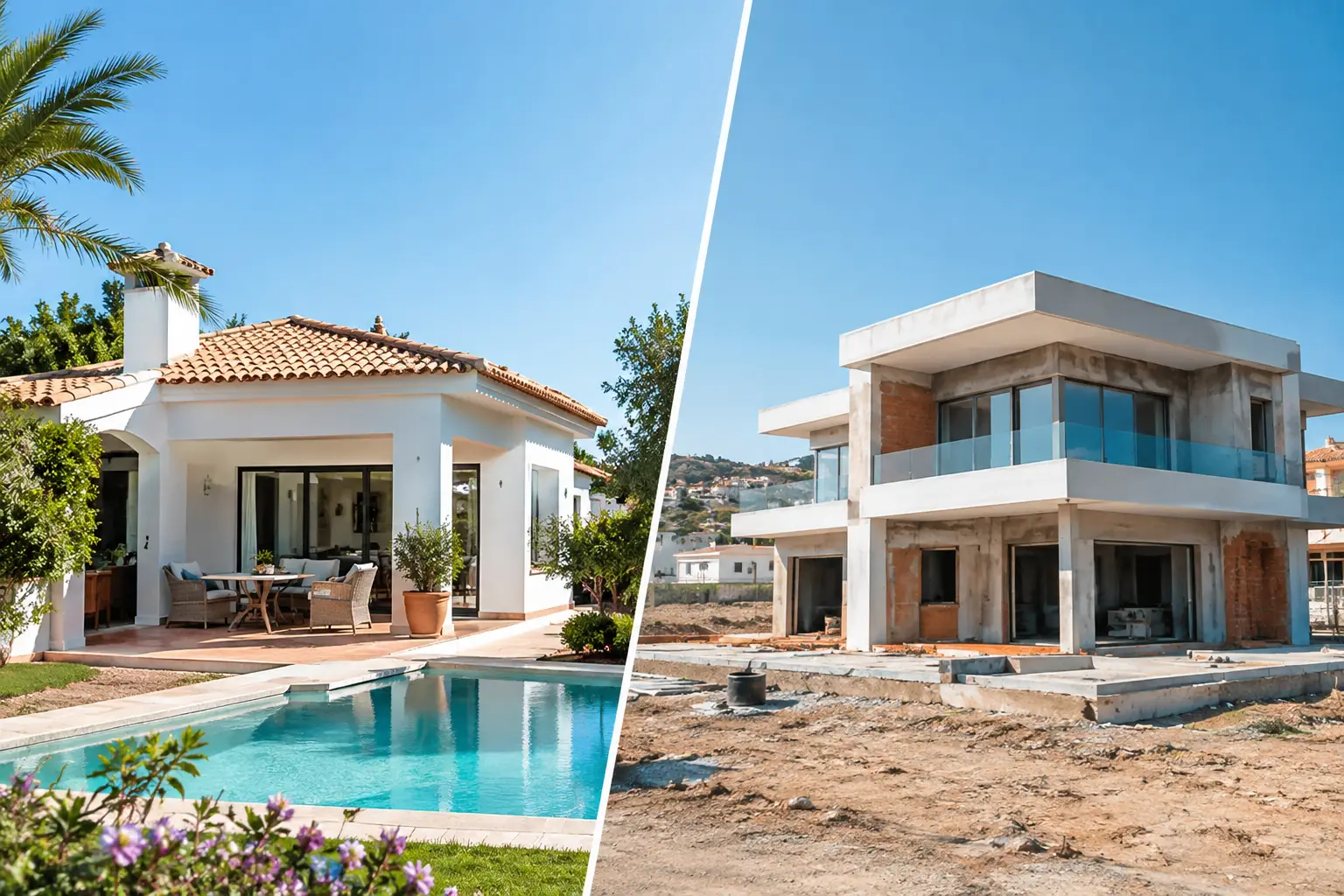
A sea view in Marbella can look equally compelling from a finished penthouse terrace or a developer’s architectural rendering. Yet resale versus off-plan Spanish homes is rarely a simple choice between old and new. It is a decision about when you want to use the property, how much execution risk you are prepared to accept, and whether the home must already fit your life or be shaped around it.
For international buyers on the Costa del Sol, the strongest decision usually begins with the property’s purpose. A family seeking a home near an international school for the coming academic year has different priorities from an investor prepared to wait for a carefully selected new development to complete. Both routes can be excellent. The right one depends on location, lifestyle, and leverage.
Resale versus off-plan Spanish homes: the central difference
A resale purchase is a property that already exists and has previously been owned. You can walk through it, assess the natural light at different times of day, understand the road access, meet the community manager, and see precisely what neighbors, landscaping, and views are already in place. In established Marbella, Benahavís, and Estepona neighborhoods, this immediacy can be particularly valuable because the appeal often lies in a mature setting that cannot be recreated quickly.
An off-plan home is bought before construction is complete, sometimes before it has begun. It offers the appeal of contemporary architecture, current energy standards, fresh communal amenities, and, in many cases, a choice of orientation, floor plan, finishes, or upgrade packages. The buyer is committing to a future asset, supported by plans, specifications, licenses, contracts, and the delivery record of the developer.
Neither is inherently safer, more profitable, or more luxurious. A poorly chosen resale home can conceal expensive deficiencies. A well-structured off-plan purchase with a proven developer and proper guarantees can be an intelligent way to secure a scarce position in a new project. The quality of the individual opportunity matters more than the label.
When a resale home has the advantage
Resale is often the more direct route for buyers who want certainty. You can inspect the actual home rather than a model unit, identify any noise or privacy issues, and evaluate whether the interior proportions work for daily living. For a buyer relocating from the United States, this can remove much of the uncertainty that comes with acquiring property from abroad.
It also provides a clearer timeline. Once legal due diligence, financing, and contract conditions are complete, a resale transaction can usually move to completion far sooner than a property still under construction. This matters for buyers coordinating a school move, a retirement date, or a defined period of personal use.
Established areas may also offer an irreplaceable sense of place. Mature gardens, walkable access to Puerto Banús or Marbella’s Golden Mile, a frontline golf position, or a proven beachfront community are often easier to judge in a resale property. The value is not merely inside the apartment or villa. It is in the daily experience of arriving, parking, walking to lunch, and returning home in August as well as January.
There is, however, a common misconception that resale means renovation. Many premium resales have been fully refurbished to a high standard, while others are attractive precisely because they offer an opportunity to redesign around a buyer’s own preferences. The distinction is important. A cosmetic update and a full technical renovation have very different budgets, permissions, and timelines.
A proper review should examine the property’s legal status, planning history where relevant, community rules, outstanding assessments, utility arrangements, and any alterations made by prior owners. For villas, this extends to boundaries, pools, terraces, drainage, access rights, and the relationship between the built reality and the registered documentation.
The case for buying off-plan
Off-plan can be compelling when a buyer values modern design and is comfortable with a longer horizon. New developments across the Costa del Sol increasingly focus on open interiors, larger terraces, energy efficiency, controlled-access communities, wellness facilities, and low-maintenance ownership. For a second-home buyer who does not need immediate occupation, these features can be highly practical.
Early buyers may have access to the strongest units: a preferred corner position, an upper-floor view, a larger garden, or a more private orientation. In a limited boutique development, that choice can be meaningful. A well-selected unit may also benefit if prices rise between reservation and completion, though this should be viewed as potential upside rather than a guarantee.
The payment structure can also preserve flexibility. Rather than paying the full purchase price at once, buyers typically make staged payments during construction, with the balance due at completion. This can support capital planning, but it requires discipline. Exchange-rate exposure, mortgage availability at completion, and the opportunity cost of capital should all be assessed before signing.
Off-plan is not a shortcut around due diligence. It requires a different form of diligence. The buyer should verify the developer’s track record, land ownership, building permit, construction timetable, technical specifications, bank guarantees for qualifying stage payments, and the precise wording of the private purchase contract. Completion dates, extension provisions, finish tolerances, and remedies for material delay deserve careful attention.
A polished show apartment is useful, but it is not the property you are buying. Views can change, landscaping takes time to mature, and the final relationship between buildings may feel different from a brochure. The question is whether the contractual documents and the physical setting support the promise being presented.
Taxes and purchase costs are not identical
The tax treatment is one practical difference between the two routes. In Andalusia, a resale purchase generally attracts transfer tax, while a new-build purchase is generally subject to VAT and stamp duty. Notary, Land Registry, legal, and, where applicable, mortgage costs should also be budgeted.
The exact figures depend on the transaction structure and prevailing rules, so buyers should obtain advice tailored to their circumstances before committing. For international purchasers, ownership structure, residency, financing, and future rental intentions can affect the broader tax conversation. This is especially relevant when the property will form part of a family’s long-term wealth planning rather than simply a holiday base.
Timing, rental plans, and the cost of waiting
A completed resale home can potentially be furnished, occupied, or prepared for rental soon after closing. That immediate usability has value. It may reduce hotel costs during a relocation, create earlier rental income where permitted and appropriate, or allow a family to begin enjoying the home without a prolonged wait.
Off-plan requires patience, and delays can happen even in professionally managed projects. Construction schedules depend on contractors, supply chains, inspections, utility connections, and final occupation documentation. A buyer should be comfortable with the possibility that handover may not align perfectly with an initial target date.
For investors, projected rental returns should be handled conservatively in either case. A new development may command a premium for design and amenities, but it may enter the market alongside many similar units. A resale property in a proven micro-location may have an established rental history, but it may need investment to meet current guest expectations. Licensing requirements and community restrictions must be checked before rental income is treated as part of the investment case.
A private decision, made with evidence
The most effective comparison is rarely between a resale home and an off-plan home in the abstract. It is between two specific opportunities: a ready-to-enjoy villa in a location that suits your family today, and a new residence whose delivery, specification, and capital profile suit your plans tomorrow.
At Triple L Estates, that evaluation is framed around more than finish level or asking price. It considers the micro-location, the ownership experience, the legal and financial path to completion, and the property’s relevance several years from now. A view is valuable, but so are privacy, access, maintenance requirements, community quality, and exit appeal.
The best purchase is the one that leaves you confident after the keys are handed over, or after the construction contract is signed. Choose the route that gives you the right degree of control, clarity, and time to enjoy the life you intend to build on the Costa del Sol.